


A coffee bag can look perfectly fine and still brew a flat, lifeless cup. The signs your coffee has gone stale usually show up in its aroma and flavor, not in an obvious change to the beans’ appearance. If your brew tastes weaker than expected, age may be part of the problem, but it isn’t the only possibility.
A roast date gives you a clearer sense of freshness than a best-by date. Staleness is also different from spoilage: older coffee often loses flavor without automatically becoming unsafe. Coffee exposed to moisture, however, needs a closer look.
This guide covers seven clues to check in your beans, their aroma, and your cup. You’ll also learn how to distinguish likely staleness from possible spoilage, rule out brewing issues, and store coffee to help preserve its flavor. If you’re ready for a fresher bag, The Roast Haus Coffee Co. roasts to order and ships coffee within 24 hours of roasting.
Key Takeaways
- Look for several signs your coffee has gone stale, especially changes in aroma and flavor, rather than relying on appearance alone.
- Stale coffee is usually a quality issue. Moisture-related spoilage calls for a different response.
- Compare a disappointing cup with your usual brewing method before deciding the beans are past their best.
- Use the roast date, packaging, storage conditions, and a familiar brew to assess freshness.
- Roasted-to-order coffee and careful storage can help you get more enjoyment from your next bag.
What does it mean when coffee has gone stale?
Stale coffee has lost some of the aroma and flavor that make it enjoyable. It may smell faint, taste flat, or lack the distinct character you expect. That change is usually about quality, not proof that the coffee is unsafe. Age alone doesn’t mean a bag has spoiled, and the signs your coffee has gone stale are different from signs of mold or moisture damage.
Freshness fades gradually as roasted coffee meets air, light, heat, and moisture. Whole beans generally hold their aroma longer than ground coffee because less surface area is exposed to air. Once ground, coffee can lose delicate aromas more quickly. Storage matters, too: an open bag left near heat or in a damp place may lose quality sooner than coffee kept sealed in suitable conditions. Coffee Bean Storage discusses how these conditions affect roasted beans.
Stale coffee versus spoiled coffee
Staleness means a loss of desirable flavor and aroma. Spoilage is a separate concern, often associated with moisture or contamination. Check the coffee and its packaging. If you see visible mold, find damp or clumped grounds, or notice a clearly abnormal odor, discard it rather than tasting it. A weak or dull cup alone doesn’t indicate a safety problem. Coffee can be old and less enjoyable without being automatically dangerous.
Why roasted coffee gradually loses freshness
Oxygen exposure gradually changes roasted coffee and diminishes the volatile compounds that give it aroma and flavor. Grinding speeds that loss by exposing more surface area to air. This is why whole beans often retain their sensory qualities longer than grounds when both are stored well. Keep coffee sealed and away from heat, light, and moisture to slow the process.
Roasted beans also release carbon dioxide after roasting, a process called degassing. This is a normal part of coffee’s transition after roasting, not evidence that the beans are spoiled. The rate varies. A roast date helps you understand when the coffee was roasted, but it can’t tell you by itself whether a cup will taste fresh today. Storage and handling affect how coffee changes after roasting.
Use the roast date as a more useful freshness clue than the best-by date. A best-by date is a package label, not a direct measure of the coffee’s aroma or flavor. Consider the roast date alongside how the coffee has been stored, then assess the beans and brew together. No single date, appearance, or smell answers every question. Look for several clues before deciding whether the issue is staleness, brewing, or possible spoilage.
Seven sensory signs your coffee has gone stale
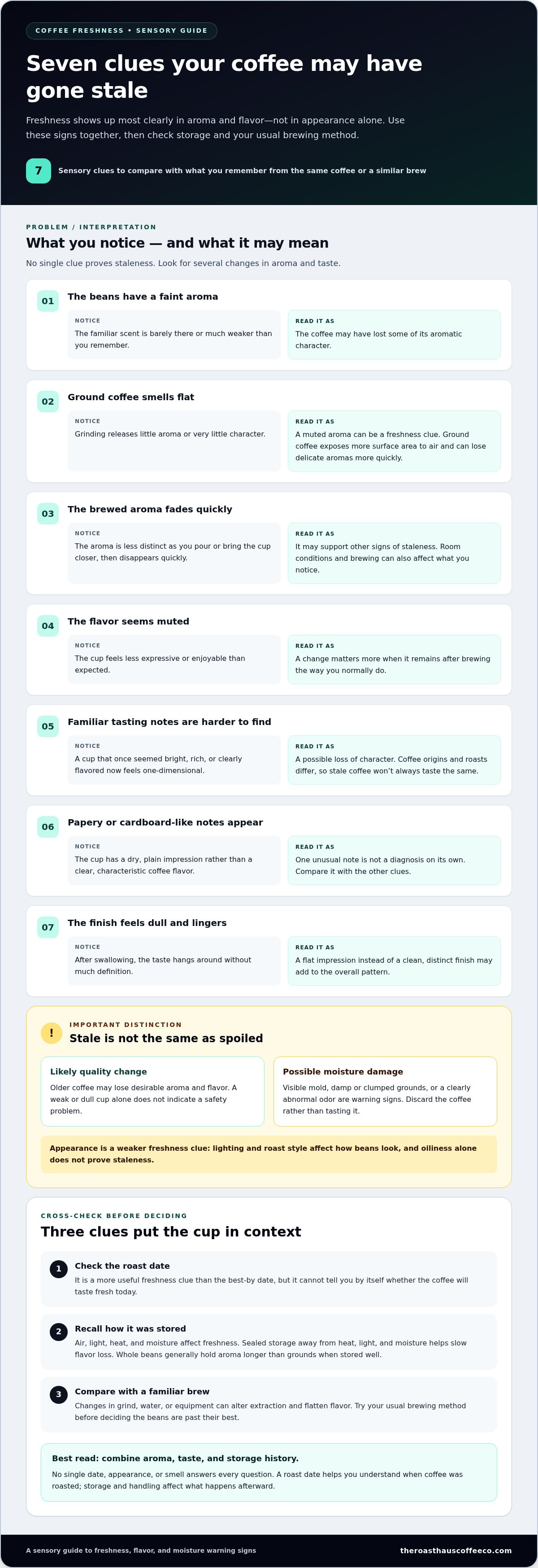
Freshness is easiest to judge by comparing what you smell and taste with what you remember from the same coffee or a similar brew. None of the clues below proves staleness on its own. A different grind, water temperature, or brew method can also change the cup, so consider the full picture.
- The beans have a faint aroma. Open the container and take a gentle sniff. If the coffee smells barely like anything, or its familiar scent is much weaker than you remember, it may have lost some of its aromatic character.
- Ground coffee smells flat. Grinding usually releases a clear burst of aroma. If freshly ground coffee smells muted or has little character, that can be a freshness clue.
- The brewed aroma fades quickly. Notice the smell as you pour and bring the cup closer. A less distinct aroma that disappears quickly may support other signs of staleness, though room conditions and brewing can affect what you notice.
- The flavor seems muted. The coffee may taste less expressive or enjoyable than you expect, even when you brew it the way you normally do.
- Familiar tasting notes are harder to find. A cup that once seemed bright, rich, or clearly flavored may now feel one-dimensional. Coffee origins and roasts differ, so stale coffee won’t always taste the same.
- You notice papery or cardboard-like notes. These can come across as a dry, plain impression rather than a clear, characteristic coffee flavor. One unusual note isn’t a diagnosis on its own.
- The finish feels dull and lingers. After swallowing, the taste may hang around without much definition, leaving a flat impression instead of a clean, distinct finish.
Pay attention to the difference between a coffee’s remembered aroma and what’s in the cup now. The International Coffee Organization (ICO) provides information on coffee quality, including factors that shape flavor and aroma. Your senses can help you notice changes, but a weak smell alone can’t establish whether coffee is safe. Visible mold, dampness, or an abnormal odor are separate concerns.
What bean appearance can and cannot tell you
Appearance is a weaker freshness clue than aroma and taste. Beans that look dry or faded may seem less fresh, but lighting and roast style affect how they appear. Some beans have naturally oily surfaces, and oiliness alone doesn’t prove staleness. Moisture, clumping, or visible mold are different warning signs. Don’t taste coffee that looks moldy or has become damp.
The strongest assessment combines aroma, taste, and storage history, rather than relying on one visual clue or a single sniff. If several clues point to a flat cup and you’re ready for a fresh bag, explore freshly roasted coffee from The Roast Haus Coffee Co., roasted to order and shipped within 24 hours of roasting.
How to tell stale coffee from a brewing problem
A disappointing cup doesn’t automatically mean the beans have gone stale. Changes in grind, water, or equipment can flatten flavor or alter extraction. Consider several clues, then compare the coffee with a familiar method before deciding. The signs your coffee has gone stale carry more weight when aroma and flavor have changed along with the beans’ storage history.
| Observed clue | Possible staleness | Alternative brewing explanation |
|---|---|---|
| Weak aroma | The beans may have lost aromatic character. | Ground coffee may have been exposed to air, or the brewed coffee may have cooled. |
| Little visible bloom | Older beans may release less carbon dioxide. | Pouring technique, grind, or water flow can change the bloom. |
| Thin or muted flavor | Staleness may have reduced the coffee’s distinct flavors. | A coarse grind, low coffee-to-water ratio, or water temperature may affect extraction. |
| Less crema on espresso | Bean freshness could be one factor. | Coffee type, grind, equipment, and espresso preparation also influence crema. |
When aroma, bloom, or crema changes
A weaker aroma or smaller bloom can support a freshness concern, but neither is a standalone test. Bloom depends on how the coffee is ground and brewed. Crema varies with the coffee and how espresso is prepared, so a thin layer alone can’t establish that beans are stale. Compare the same coffee using your usual method, or brew familiar beans as a reference. Coffee quality is shaped by several factors, as the Coffee Quality Institute (CQI)’s broader focus on coffee quality reflects.
Check grind, water, and recipe before blaming the beans
Think about what changed since your last satisfying cup. Did you adjust the grind size or coffee-to-water ratio? Are you using different water, a different temperature, or equipment that needs cleaning? These variables can shift extraction and taste even when the coffee hasn’t changed. Keep the dose, grind, water, and method consistent for a useful comparison. For more on how grind affects flavor, see this guide to grinding coffee beans for better flavor.
No single brew symptom reliably diagnoses stale coffee. If aroma and flavor seem muted across a familiar recipe, and age or storage may have contributed, staleness becomes more plausible. If the cup improves after you correct a brewing change, the beans may not be the main issue. Compare carefully before replacing them.
Use this checklist to assess and store coffee
A repeatable check helps separate a freshness issue from a brew that simply didn’t go to plan. Look at the package and storage history first, then use your nose and a familiar recipe. The signs your coffee has gone stale are more convincing when several clues point in the same direction, rather than just one date or one disappointing cup.
A quick five-step freshness check
- Read the roast date. Use it to understand when the coffee was roasted. Also note when you opened the package, since that marks when its contents began getting more exposure to air.
- Inspect the packaging. Check whether it closes securely and whether it has been left open, damaged, or exposed to moisture. The package’s condition can help explain how well the coffee has been protected.
- Recall how it was stored. Consider whether the beans stayed dry and sealed between uses or sat near heat, sunlight, steam, or strong odors.
- Smell the coffee. Open the package and notice whether the aroma is clear and familiar or unusually faint. Treat this as one clue, not a safety test on its own.
- Brew a familiar cup. Use your usual coffee-to-water ratio, grind, and method. Taste the result and compare it with what you expect from that coffee before deciding it has lost quality.
There’s no universal freshness deadline that applies to every bag. Roast, packaging, and handling all affect how coffee changes over time. Whole beans generally preserve aroma better than grounds because less surface area is exposed. If you buy whole beans, grinding just before brewing can help retain more aroma until you make the cup.
Storage habits that protect coffee flavor
After opening, move coffee into an airtight, opaque container if its original packaging won’t seal securely. Keep it in a cool, dry, dark place, away from direct sunlight, heat, steam, and strong odors. Avoid storing it beside a kettle or stove, where warmth and moisture can reach it during everyday use. Handle the coffee with dry hands or a dry scoop, then reseal it promptly.
Consistent brewing makes freshness checks more useful. Keep your usual recipe steady while you assess the coffee, and use a beginner’s guide to making coffee to establish a repeatable method. If your check points to coffee that has lost the qualities you enjoy, choose a fresh replacement from The Roast Haus Coffee Co. Coffee is roasted to order and shipped within 24 hours of roasting. Explore freshly roasted coffee, then use the roast date and good storage habits to keep track of your next bag.
Choose roasted-to-order coffee when freshness matters
A roast date gives you a useful reference point, but freshness also depends on what happens after roasting. Packaging, shipping, opening, and storage at home all affect how aroma and flavor hold up. If your checks suggest it’s time for a replacement, roasted-to-order coffee offers a clear starting point: you can see when the coffee was roasted and consider how that timing fits your routine.
What roasted to order means for your next bag
Roasted to order means the coffee is roasted in response to orders, rather than selected from coffee roasted earlier and held in stock. The Roast Haus Coffee Co. is a family-owned, small-batch roastery, and its coffee ships within 24 hours of roasting. That’s a fulfillment detail, not a promise about how long a bag will retain its best flavor. The roast date and your storage habits still matter.
Knowing the process can help you make a more informed choice, especially when comparing bags by roast date. Learn more about what roasted-to-order coffee means and how roasting and shipping fit into your freshness assessment. Once your coffee arrives, keep it sealed and away from heat, light, and moisture to help protect its aroma.
Find coffee that suits your routine
Think about how you brew before choosing your next bag. Whole beans are a practical fit if you have a grinder and can grind coffee just before brewing. If convenience matters more or you don’t grind at home, ground coffee may better match your routine. Neither format fixes every freshness concern, so choose the one you can store well and use consistently.
Your preferred brew method and taste matter, too. Consider whether you usually make coffee for one cup or several, and whether you prefer a familiar, straightforward profile or want to try something different. A coffee beans beginner’s guide can help you think through the options without treating one roast or format as right for everyone.
Freshness is a chain of small choices: check the roast date, protect the coffee after opening, and use a brewing method you can repeat. The Roast Haus Coffee Co. has roasted coffee since 2014, with a family-owned approach and small-batch production. Choose from coffees such as Kenya AA Supreme, Ethiopia Limu Organic, Honduras Morning Splendeur, or The All Day Sampler. If you’re ready for a new bag, explore coffee roasted to order and find an option that suits how you like to brew.
Make your next cup a fresh start
Use the signs your coffee has gone stale as clues, not a reason to second-guess every bag or discard coffee based on age alone. Let your senses guide the decision, and make one small change for your next brew: choose coffee with a clear roast date, store it carefully, and match the format to how you actually make coffee. A routine that works for you is easier to maintain and helps you enjoy each bag at its best.
If you’re ready to refresh your coffee shelf, choose from coffee roasted to order by a family-owned, small-batch roastery in Wyandotte, Oklahoma. Coffee ships within 24 hours of roasting, giving you a clear reference point as you plan your next cup. Pick a bag that fits your preferences and brewing habits, then keep it sealed and protected at home.
Explore coffee roasted to order and choose your next bag from The Roast Haus Coffee Co.
Frequently Asked Questions
Does stale coffee have less caffeine?
Stale coffee usually doesn’t have meaningfully less caffeine just because its aroma and flavor have faded. Staleness mainly affects the compounds responsible for the coffee’s sensory character. The amount of caffeine in your cup depends more on factors such as the coffee itself, how much you use, and how you brew it. If an older cup tastes weak, that doesn’t necessarily mean it contains less caffeine.
Can coffee go stale in an unopened bag?
Yes, coffee can lose freshness in an unopened bag. A sealed package slows exposure, but it doesn’t stop time or guarantee that the coffee’s aroma and flavor remain unchanged. Packaging condition and storage matter. For example, a bag kept for a long time in a warm cupboard may taste less lively when opened. Check for a roast date, then assess the aroma and condition after opening.
Is coffee past its best-by date automatically unsafe?
No, a coffee bag past its best-by date isn’t automatically unsafe. That date doesn’t tell you exactly how the coffee will taste, and age alone doesn’t prove spoilage. Before brewing, check that the package and coffee are dry and free from visible mold or unusual odors. If the coffee looks or smells abnormal, discard it. Otherwise, its flavor may simply be less satisfying.
Can I freeze coffee beans to preserve freshness?
Yes, freezing can help preserve coffee beans if you protect them from air and moisture. Divide the beans into portions you’ll use at once, seal each portion in an airtight, freezer-safe container, and avoid repeatedly opening and closing the same container. Let a portion come to room temperature while still sealed before opening it. This helps limit condensation on cold beans, which can affect their condition.
Can stale coffee beans be used for cold brew?
Yes, you can use stale beans for cold brew if they’re dry and show no signs of spoilage. Cold brewing may produce a smoother-tasting drink, but it won’t restore aromas the beans have lost. If the coffee already tastes papery or flat when brewed, those qualities may still come through. Try a small batch first, and discard beans that are damp, moldy, or smell abnormal.
Does brewed coffee go stale overnight?
Brewed coffee can lose flavor overnight, especially if left uncovered, but that change is different from beans gradually losing freshness. For a better-tasting cup the next day, cool and refrigerate plain coffee in a clean, covered container, then assess its smell and taste before drinking. Coffee with milk or another perishable ingredient needs more careful handling. If it was left out for an extended period, discard it.
