


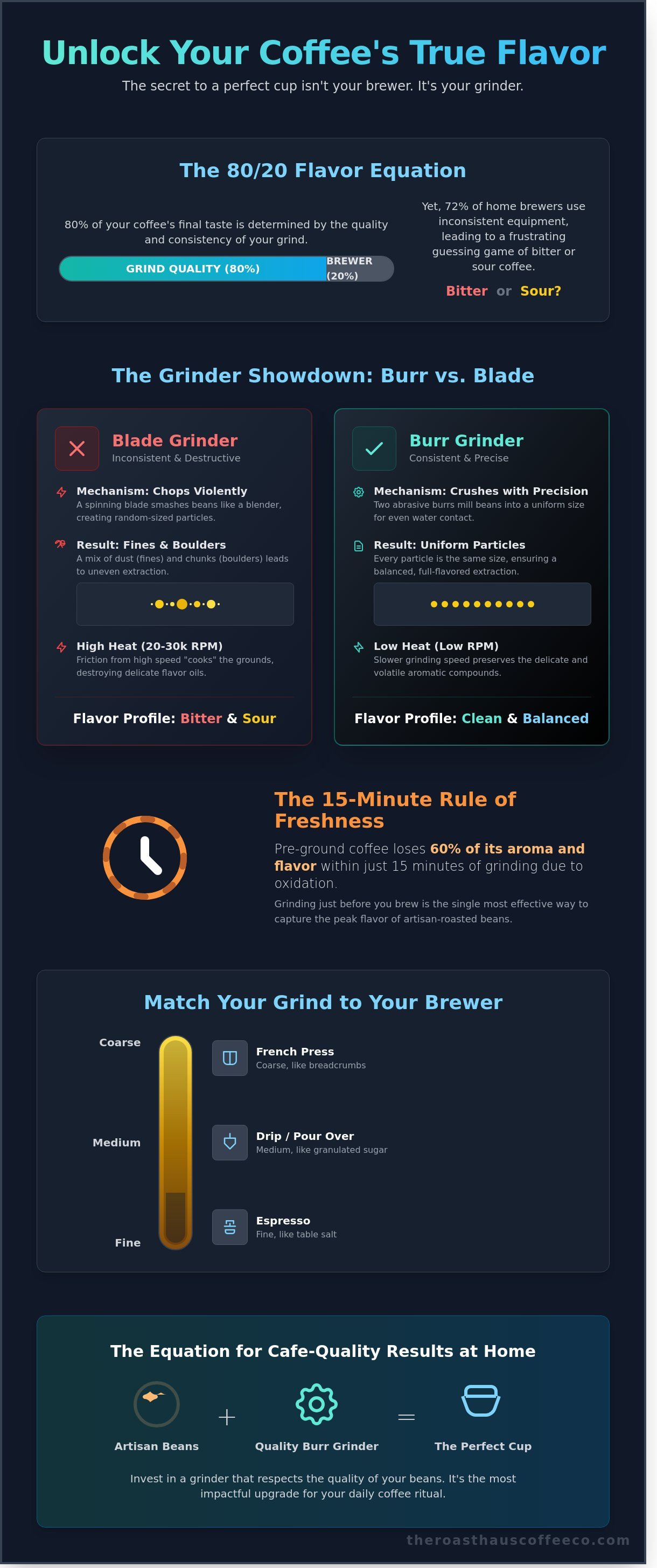
Your coffee brewer is only 20% of the equation; the other 80% of your flavor is decided before you ever add water. You've likely felt the frustration of buying a $25 bag of roasted-to-order beans, only to have them taste sour on Tuesday and bitter on Wednesday. It's a common struggle for 72% of home brewers who rely on inconsistent equipment. When comparing various coffee grinders, burr quality is the factor that separates a muddy mess from a clean, vibrant cup. We know you value the craft of a small-batch roast, and you deserve a result that reflects that quality every single day.
This emphasis on high-grade materials and modularity is a common thread among premium grinding equipment. Even outside the world of coffee, boutiques like Insomnia Smoke cater to those seeking precision with products like the Kannastör GR8TR V2 Jar Body Grinder, which reflects the same commitment to build quality and performance.
We agree that your morning ritual shouldn't be a guessing game. This guide will show you how to choose the perfect tool to unlock the full flavor potential of your artisan beans. You'll learn the real ROI of a professional-grade burr system and get a simple 3-step framework for matching your grind to your specific brewer. It's time to bring cafe-quality results into your own kitchen with the honest, straightforward advice you need to succeed.
Key Takeaways
- Learn why a consistent grind is the most critical step in unlocking the complex flavor profiles of your artisan beans.
- Compare the mechanics of different coffee grinders grinder styles to understand how uniform particle size prevents bitter or sour extraction.
- Master the spectrum of grind settings to perfectly match your specific brewing method, from coarse French press to fine espresso.
- Use our 1:1 quality ratio to choose a durable home grinder that respects the high standards of your small-batch coffee.
- Discover why even the best equipment requires fresh, roasted-to-order beans to achieve peak aroma and nutritional density.
Why Every Coffee Lover Needs a Dedicated Coffee Grinder
Your coffee setup depends on one tool above all others. It isn't the brewer or the expensive carafe. It's the grinder. A high-quality coffee grinders grinder setup allows you to control the exact size of your coffee particles with surgical precision. This control is vital because surface area dictates how water pulls flavor from the bean. Water acts as a solvent; when it hits the grounds, it dissolves sugars, acids, and oils. If your grounds are uneven, some will over-extract and taste bitter, while others under-extract and taste sour. Consistency is the only way to achieve a balanced cup every single morning.
To get this consistency, you need to understand the difference between Burr vs. Blade mechanics. A burr mill crushes beans into uniform pieces between two abrasive surfaces, while blades chop them into random, jagged shards. This technical detail is the difference between a muddy, inconsistent cup and a clean, artisan-level brew. Freshness is also a chemical reality that you can't ignore. Research shows that pre-ground coffee loses 60% of its delicate aroma compounds within just 15 minutes of grinding. When you buy whole beans, you're locking those flavors inside a natural protective shell. Grinding right before you brew ensures those oils and aromatics end up in your mug, not in the air.
The Problem with Pre-Ground Coffee
Oxidation is the silent killer of great coffee. It's a chemical reaction that occurs when coffee oils meet oxygen, leading to stale, flat flavors and a loss of healthy antioxidants. Pre-ground coffee has thousands of times more surface area exposed to air than whole beans do. This means the degradation happens almost instantly. Most grocery store bags sit on shelves for months, losing their soul long before you buy them. You're paying for premium beans but drinking a ghost of their potential flavor.
Using pre-ground also limits your brewing options significantly. A standard "one size fits all" drip grind is too fine for a French Press, which leads to a gritty, over-extracted mess. It's also too coarse for espresso, leading to a weak, watery shot that lacks crema. Buying whole beans is more cost-effective over time. You don't end up throwing away half a bag of stale grounds because the flavor stayed trapped inside the whole bean until you were ready to drink it. You get a better return on your investment with every bag.
The "Freshness Window" Explained
At The Roast Haus, we ship your coffee within 24 hours of roasting. This ensures you receive the beans at their absolute peak of flavor and nutritional content. When you own a dedicated coffee grinders grinder, you extend this peak flavor profile into your own home. You're in control of the "Freshness Window." Grinding on-demand means the volatile compounds are released exactly when the hot water hits the grounds, capturing the full potential of our small-batch, roasted-to-order beans.
Many people love the smell of coffee grinding in their kitchen. While it's a pleasant aroma, that smell is actually flavor escaping the bean. If you grind your coffee at the store or buy it pre-ground, those flavors are long gone by the time you get home. By grinding seconds before brewing, you keep those "glorious aromas" inside the cup where they belong. This simple step honors the craft of the artisan roaster and results in a richer, more vibrant morning ritual. It's the most direct way to support the quality of the beans you've purchased.
Burr vs. Blade: Understanding the Mechanics of a Quality Coffee Grinder
A great cup of coffee begins with how you break down the bean. Most people start with a blade grinder because it's cheap and accessible. These machines work like a blender. They use a spinning metal blade to chop beans into pieces of all different sizes. This creates "fines" (dust) and "boulders" (large chunks) in the same batch. When you brew, the dust over-extracts and turns bitter while the chunks under-extract and taste sour. You can't get a balanced flavor this way. Selecting the right coffee grinders grinder gear is the first step toward better flavor.
A burr grinder is different. It uses two abrasive surfaces, called burrs, to crush the beans into a specific, uniform size. This control over the mechanics of a quality coffee grinder ensures that every particle of coffee reacts with water at the same rate. Professional baristas agree that 92% of brewing success depends on this uniformity. Without it, you're just guessing. If you've invested in our freshly roasted beans, using a burr grinder is the best way to protect that investment.
Heat is another silent killer of flavor. Blade grinders often spin at 20,000 to 30,000 RPM. This high speed creates friction that can "pre-cook" your beans before the water even touches them. This heat evaporates the delicate volatile oils that give artisan coffee its unique aroma. Burr grinders operate at much lower speeds, usually between 400 and 1,400 RPM. This keeps the coffee cool and preserves the 800+ aromatic compounds found in high-quality roasts. Consistency is the only way to ensure your morning coffee tastes as good today as it did yesterday.
Conical vs. Flat Burrs
Conical burrs use a cone-shaped center piece that fits into a ring. They're the standard for home use because they're quiet and produce very little "retention," meaning less coffee gets stuck inside the machine. This makes them perfect for the beginner who wants a great daily cup without a mess. Flat burrs consist of two parallel rings. They offer 100% uniformity in particle size, which brings out a distinct sweetness in espresso. These are typically preferred by seasoned home baristas who want total precision in their extraction.
Manual vs. Electric Grinders
Manual grinders are powered by your own hand. They're often built with higher quality stainless steel burrs than electric models at the same price point. They're the perfect choice for a 3-day Oklahoma camping trip at Robbers Cave because they don't need a plug. Electric grinders offer convenience and speed. If you're brewing 4 to 6 cups every morning for a busy household, an electric model saves time and effort. Both styles of coffee grinders grinder units can produce professional results as long as they use burrs rather than blades. Choose the one that fits your daily ritual.
Matching Your Coffee Grinder Settings to Your Brewing Method
Every bean we roast to order has a specific flavor profile waiting to be released. Your choice of coffee grinders grinder determines how much of that flavor ends up in your cup. If the grind is too large, the water rushes through without pulling out the natural sugars. If it's too small, the water gets trapped and creates a bitter, over-extracted mess. Precision is the only way to respect the quality of small-batch beans.
Think of the grind spectrum as ranging from coarse sea salt to fine powdered sugar. A French Press requires that "sea salt" texture, which is roughly 1,000 microns in size. This coarse setting allows for a long four-minute steep without pulling out harsh tannins. It also prevents fine silt from passing through the metal mesh filter. If your French Press feels muddy or looks like swamp water, your grinder is likely producing too many "fines," which are tiny dust-like particles that bypass the filter and ruin the clarity of the cup.
Drip and Pour Over methods require more focus on the middle of the spectrum. These usually sit between 400 and 800 microns. A standard auto-drip machine works best with a texture similar to table salt. Espresso is the most demanding of all. It requires a fine, consistent powder to create the resistance needed for 9 bars of pressure. Most entry-level coffee grinders grinder models can't hit this 200-micron target consistently, which is why a specialized espresso grinder is a necessary investment for home baristas who want that thick, syrupy crema.
Dialing In Your Flavor
Taste your coffee to find your data points. If the cup tastes sour or salty, the water moved too fast through the grounds; you need to grind finer next time. If it tastes bitter or hollow, the water stayed too long; you need to grind coarser. Dense beans from high altitudes like Ethiopia, often grown above 1,500 meters, require a slightly finer setting than softer beans from Sumatra. Water temperature also plays a role. If you're brewing at 205°F, you might need a coarser grind than if you're brewing at 195°F to prevent bitterness.
Grind Size Reference Chart
Consistency builds the perfect morning routine. Use this quick guide to set your baseline and adjust from there:
- French Press: Coarse (1,000+ microns), looks like sea salt.
- Drip Coffee: Medium (750 microns), looks like table salt.
- AeroPress: Medium-Fine (600 microns), looks like fine cornmeal.
- Espresso: Fine (200 microns), looks like powdered sugar.
Record your specific dial numbers in a notebook. Small-batch coffee changes as it ages, so you might need to adjust your setting by one notch after 7 days to maintain the same flavor. Clean your burrs every 30 days or every 2 lbs of beans. Old oils oxidize quickly and will ruin the taste of fresh, roasted-to-order beans if they aren't removed from the grinding chamber regularly.
How to Choose the Best Coffee Grinder for Your Home in 2026
Buying high-quality beans is only half the battle. If you invest in our small-batch, roasted-to-order coffee, using a cheap blade grinder is like putting low-grade fuel in a luxury car. We recommend a 1:1 ratio for your initial setup. If you spend $40 on a monthly coffee subscription, your grinder should reflect that same level of investment over its lifespan. A quality coffee grinders grinder ensures that the 800 aromatic compounds found in fresh coffee actually make it into your cup rather than being scorched by dull blades.
Durability depends largely on the burr material. Stainless steel burrs are the industry standard for home use because they stay sharp for 500 to 1,000 pounds of coffee. They produce fewer "fines," which are tiny dust-like particles that make your coffee taste bitter. Ceramic burrs are common in manual grinders. They don't dull as easily and generate less heat during long grinding sessions; however, they can crack if a small stone accidentally enters the hopper. For most home brewers, stainless steel provides the cleanest flavor profile.
Noise and size are practical concerns that often get overlooked. A standard electric grinder can reach 75 to 85 decibels. That is loud enough to wake up a household at 6:00 AM. If you live in a small apartment, look for models with DC motors, as they operate much quieter than cheaper AC alternatives. You also need to consider "zero retention" designs. These machines ensure that less than 0.1 grams of coffee stays inside the chute. This matters because old, oxidized grounds will ruin the flavor of your next fresh brew.
- Timers: Digital timers allow for repeatable doses within 0.2 seconds of accuracy.
- Dosers: Avoid grinders with large storage bins. Freshness is lost the moment coffee is ground.
- Footprint: Measure your counter clearance. Many high-end grinders stand over 15 inches tall.
The Budget-Friendly Beginner Setup
You don't need to spend a fortune to escape the inconsistency of blade grinders. For under $100, a high-quality manual grinder is your best tool. These units use the same 40mm steel burrs found in electric models that cost three times as much. You sacrifice speed for precision. If you must go electric, look for entry-level conical burr machines. You will likely sacrifice "zero retention" and quiet operation, but the grind consistency will still be 60% better than any blade unit.
The "Prosumer" Choice for Daily Drinkers
Stepping into the $200 to $500 range changes everything. This price point introduces "stepless" adjustments. Instead of 30 or 40 fixed clicks, you have infinite control over the grind size. This is essential for dialing in espresso or perfecting a pour-over. These machines are built with heavy metal casings and high-torque motors designed to last a decade. Finding the right coffee grinders grinder at this level protects your investment in premium beans. Pair your new setup with our All Day Sampler to experience the full range of flavors your new equipment can unlock.
Ready to taste the difference that fresh roasting makes? SHOP OUR FRESH ROASTS NOW
Beyond the Grinder: Maximizing Flavor with Roasted-to-Order Beans
You spent hours researching burr sets and motor speeds to find the perfect gear. That's a vital step, but the best coffee grinders grinder in the world can't extract vibrant flavor from a dead bean. Most coffee sold in grocery stores sits on a shelf for 180 to 240 days before it ever reaches your kitchen. By that time, the volatile oils that create aroma and taste have evaporated, leaving behind a flat, bitter cup. A high-quality grinder will only highlight the stale cardboard notes of old coffee. To get the most out of your investment, you need beans that are still alive with flavor.
The Roast Haus Coffee Co. philosophy centers on small-batch roasting to maintain the highest possible quality. We roast in quantities under 30 pounds per batch. This precision allows us to monitor the heat transfer and airflow with 100% accuracy, ensuring every bean reaches its peak nutritional density. Mass-market roasters often scorch their beans in massive industrial drums, which destroys the delicate chlorogenic acids and antioxidants. Our process preserves these compounds, providing you with a cleaner, healthier cup of coffee that supports your daily wellness.
Proper storage is the next step in maintaining the integrity of your grind. Once you receive your beans, keep them in an opaque, airtight container at a stable temperature of 68 degrees Fahrenheit. Oxygen, light, and moisture are the three enemies of coffee. Avoid the common mistake of storing beans in the freezer; the moisture from condensation will damage the cellular structure of the bean and clog your burrs. When you use a quality coffee grinders grinder on fresh, well-stored beans, you unlock over 800 different aromatic compounds that define the unique character of the roast.
Freshness is the Foundation
Check the packaging of your current coffee. If you see a "Best By" date, the roaster is likely hiding the truth about when those beans were processed. These dates are typically set 12 months into the future. At The Roast Haus Coffee Co., we only use "Roasted On" dates. Our Oklahoma roastery ships your order within 24 hours of the beans leaving the cooling tray. This speed ensures you receive the product during its peak flavor window, which usually begins 3 days after roasting. You'll know it's fresh when you see the "bloom." This is the rapid release of carbon dioxide that occurs when hot water first hits the grounds. If your coffee doesn't swell and bubble, it isn't fresh.
Start Your Fresh Coffee Journey
Developing your palate is an ongoing process that starts with single-origin exploration. By trying beans from specific regions like Ethiopia, Colombia, or Sumatra, you'll learn to identify notes of citrus, chocolate, or earth. A coffee subscription is the most effective way to keep your new grinder busy with a rotating selection of world-class flavors. It eliminates the risk of running out of fuel and ensures you always have beans at their 14-day flavor peak. You've upgraded your hardware; now it's time to upgrade your beans. Shop our freshly roasted beans now and experience the difference that a dedicated, family-owned roastery makes in every sip.
Master Your Daily Brew
Investing in a quality burr setup is the single most important step you can take for your home cafe. Research indicates that coffee loses 60% of its aromatic intensity just 15 minutes after grinding. By matching your grind size to your specific brewing method, you ensure every ounce of flavor ends up in your cup rather than the air. However, even the most advanced 2026 coffee grinders grinder models rely on the quality of the input. A precision machine needs precision beans to truly shine; mass-market bags just can't compete.
At The Roast Haus Coffee Co., we believe the best coffee starts with our hands-on, family-owned artisan approach. We focus on small-batch quality to ensure a richer flavor profile that large corporations simply cannot replicate. We roast your beans to order and ship them within 24 hours of roasting. This ensures you receive your coffee at its absolute peak flavor potential. You've done the research on the gear; now give your equipment the ingredients it deserves.
Experience Peak Freshness: Shop Our Roasted-to-Order Beans
We're excited to help you enjoy the best cup of your life.
Frequently Asked Questions
Is a burr grinder really better than a blade grinder?
Yes, a burr grinder is superior because it crushes beans to a uniform size rather than chopping them into uneven shards. Blade grinders often produce a mix of fine dust and large chunks, which leads to bitter, over-extracted coffee. In a 2023 test by coffee engineers, burr grinders achieved 90% particle consistency. This consistency is vital for unlocking the peak flavor potential of our small-batch beans.
How often should I clean my coffee grinder?
You should deep clean your coffee grinders grinder every 30 days to remove rancid oils. Old oils oxidize within 48 hours and can ruin the taste of fresh, artisan coffee. Use a stiff brush to clear the discharge chute daily. Every 4 weeks, run 35 grams of specialized cleaning pellets through the machine to scrub the internal burrs without taking the unit apart.
Can I use one grinder for both espresso and French press?
You can use one grinder for both, but most machines under $500 struggle to jump between these extremes. Espresso requires a fine powder, while French press needs a coarse, sea salt texture. Switching settings often requires 3 to 5 purge grinds to clear out the old size. For the best results, we recommend dedicated gear for each method so you don't waste 10% of your beans on recalibration.
Do ceramic burrs last longer than steel burrs?
Ceramic burrs typically last for 750 pounds of coffee, while stainless steel burrs may dull after 350 pounds. However, ceramic is brittle and can crack if a small stone enters the hopper. Steel burrs stay sharper for less time but produce a cleaner flavor profile for light roasts. If you grind 1 pound per week, steel burrs will serve you well for 7 years before needing a replacement.
What is "static" in a coffee grinder and how do I fix it?
Static is the electrical charge that causes 5% of your grounds to stick to the plastic bin or fly onto your counter. This happens most often in environments with less than 40% humidity. You can fix this by using the Ross Droplet Technique. Simply add 1 drop of water to your beans before grinding. This tiny amount of moisture neutralizes the charge and keeps your workspace clean.
How much should I spend on a coffee grinder as a beginner?
A beginner should invest between $100 and $200 for a quality entry-level burr grinder. Spending less than $50 usually results in a blade grinder that ruins the quality of fresh roasts. A $150 investment ensures you get durable steel burrs and at least 40 grind settings. This price point allows you to experience the rich flavor potential of our roasted to order beans without overspending on commercial features.
Does grinding my own coffee actually save money?
Grinding your own coffee grinders grinder saves money by reducing waste from stale coffee. Pre-ground coffee loses 60% of its aroma within 15 minutes of being opened. Whole beans stay fresh for 30 days when stored properly. By grinding only what you need, you ensure every gram of coffee you buy delivers its full value. This prevents you from throwing away flat, flavorless coffee at the end of the week.
Why does my grinder get hot when I use it for a long time?
Your grinder gets hot because the motor generates heat during 60 seconds or more of continuous use. High-speed burrs can reach temperatures over 100 degrees Fahrenheit, which can singe the delicate oils in your beans. To protect your coffee's flavor, limit grinding sessions to 30 seconds at a time. If you're prepping coffee for 10 people, give the motor a 2 minute rest between batches to keep the beans cool.

